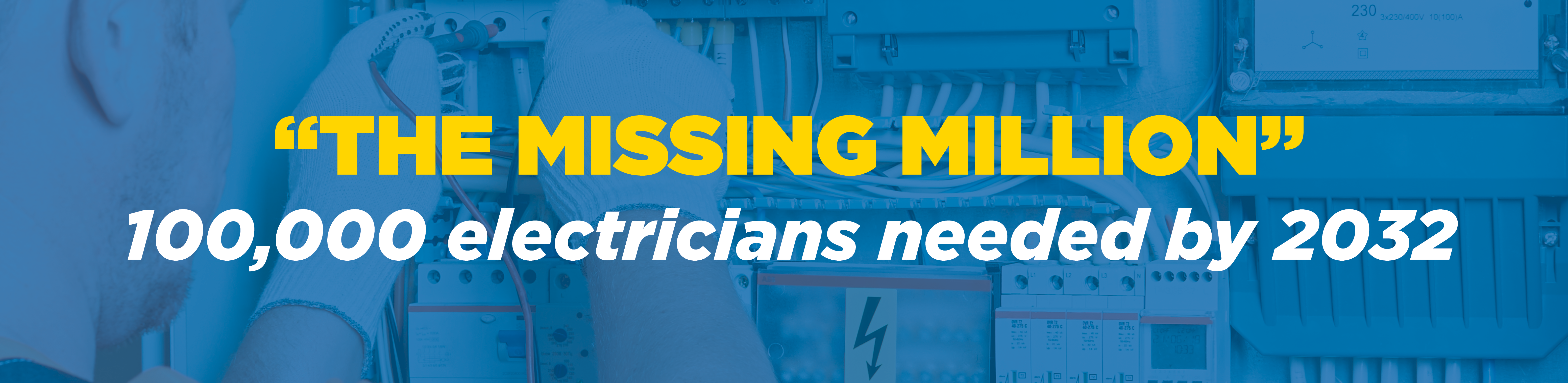
The “Missing Million” has been coined after an ‘alarming’ skills gap was identified from the UK Trade Skills Index 2023. This gap means that almost 1 million new tradespeople need to join the construction and trade industry by 2032 due to several factors, including an ageing workforce, and a loss of EU workers post-Brexit. 100,000 of these tradespeople will come from the electrical sector.
Job vacancies in the trade are at a record high. On top of this, there is still a growing demand for young people to enter the industry through apprenticeships - which has increased by 38% above the average level of the past five years. At present, there is a nationwide push for more women and girls to join the construction career pathway, as 85% of the workforce is currently male, leaving a huge gap that could be filled.
Why get into Electrical?
According to government data, electricians are the highest-paid skilled tradespeople. Even more so recently, in that for the past two years, the skills shortage has caused an acceleration in wages.
There are endless pathways in construction, and therefore good prospects for career progression. Skilled workers can become managers, supervisors or even set up their own companies. The amount of transferable skills in electrical cannot be underestimated. Not only is someone able to move up the career ladder, but moving sideways is also a possibility. New professional connections via networking can mean that opportunities in new projects can arise, potentially supplementing income via other streams such as property development.
Job security is a huge factor, as electricity will always be used. Technology and AI cannot always fix themselves, no matter how much they advance. Electricians will always be needed to fix technology.
Electricians have a high job satisfaction rate. Workers suggest this is due to the role being hands-on, and the feeling of accomplishment when problem-solving and seeing a project come to fruition. Teamwork is also a large contribution to the career being enjoyable, in meeting new people, collaborating with other professionals and mentoring new recruits. Travelling can be a big part of the job, as new projects are always coming up all over the world.
Not sure where to start?
Unlike most Higher Education routes that can leave university students with an average of £45,000 of debt, electrician courses are very affordable and can take 3 days, instead of 3-5 years to complete.
The IET Wiring Regulations are the national standard for the UK for electrical installations in domestic, commercial and industrial settings. BS 7671 18th Edition training course is ideal for budding electricians starting out, who need to achieve an understanding of basic electrical theory and principles and compliance with the requirements of the IET Wiring Regulations. Once an electrician has qualified to install electrical equipment, the
next progression would be to become qualified to inspect and test these
installations. HSS now offer the City & Guilds Initial and Periodic Inspection and Testing of Electrical Installations course, allowing an electrician to inspect and sign
off an installation, once recognised that it is safe and meets the latest standards.
While not a legal requirement, it's common for electricians to register with the National Inspection Council for Electrical Installation Contracting (NICEIC) as a way of proving their competence and high level of skill.
To gain access to construction sites, most sites will ask for a CSCS card to prove your identity, skill level and understanding of site health and safety. However, for electricians, the ECS Card (Electrotechnical Certification Scheme) is affiliated with, and approved by CSCS, as an equivalent competence card. This is also known in Scotland as SJIB (Scottish Joint Industry Board) and can also be applied for once a Health, Safety and Environmental Assessment is completed. Delegates for the ECS Electrical Safety Unit assessment are assumed to have a level of knowledge and competency in basic electrical theory and principles. It is strongly advised that all delegates undertake suitable training prior to undertaking the ECS Electrical Safety Unit assessment. More information on this can be found on the ECS Card website.
Where can Electrical training take me?
By upskilling, an electrician can expand their ability to complete a range of tasks, increase their job prospects and in turn, earn a higher salary.
There are many different electrical avenues to pursue, from PAT testing, to working with high voltage equipment in the MOD or healthcare sectors, and everything in between.
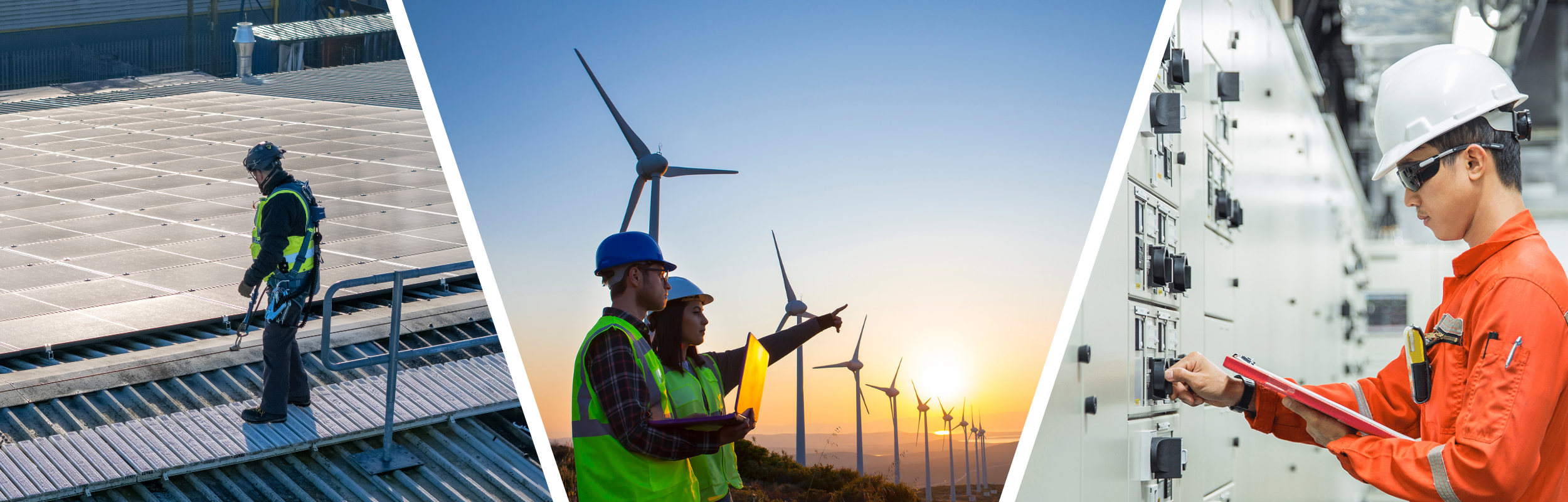
Renewable energy is a hot topic at present and is expected to carry the electrical industry into the future. It allows for many different career pathways including managing wind farms, solar panel installation and electric vehicle charging point design & installation.
There are also courses that are complementary to an electrician who is looking to upskill. Some jobs may require work that isn’t on the ground. A PASMA Towers for Users or an IPAF Dual Operator course can allow an electrician to use mobile elevated equipment and machinery to safely complete work while at height. A Harness training course will maximise safety when using this equipment. Go even higher with Rooftop Worker and Tower Climbing courses to enable working outdoors on top of buildings or up telegraph poles and wind turbines.
A First Aid course is beneficial for everyone, no matter the industry or job title. If an accident were to happen, a First Aider on scene can often be the difference between life or death.
Latest update to the 18th Edition (Amendment 3)
This amendment was published on 31 July 2024 and is an additional amendment to the current Wiring Regulations, to ensure safety standards are upheld and workers are protected as electrical practices evolve. This amendment will be included in teaching of all 18th Edition training courses.
There is a free downloadable PDF which outlines the changes and will be used alongside the existing brown book (BS 7671:2018+A2:2022). This can be downloaded from IET’s website.